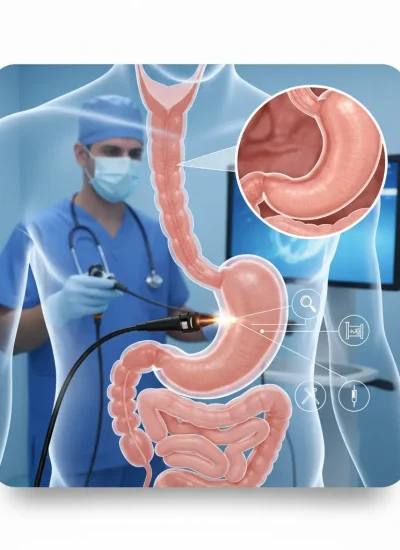



Our Department of Gastroenterology and Hepatology is dedicated to the study and treatment of disorders affecting the entire digestive system, including the esophagus, stomach, small and large bowel, pancreas, liver, and biliary system.
Endoscopy involves using a very thin camera on the end of a flexible tube to look inside the digestive tract for diagnosis and treatment. Our services are available on all weekdays and include 24-hour emergency coverage.
This procedure diagnoses problems in the esophagus (gullet), stomach, and upper small bowel.
Diagnostic:
Therapeutic (Treatment):
This procedure investigates problems in the anus, rectum, large, and small bowel, often used for symptoms like bleeding, chronic diarrhea, constipation, or unexplained weight loss.
Diagnostic:
Therapeutic (Treatment)
A specialized procedure used primarily to treat disorders of the biliary and pancreatic ducts.
For Bile Ducts:
Removal of bile duct stones (including mechanical lithotripsy for large stones).
Treatment of bile duct infections (cholangitis) and relieving jaundice by drainage and stenting.
Placing metal stents for inoperable bile duct, pancreatic, or gallbladder cancers.
Stopping bile leakage after surgery or trauma.
For Pancreas:
Relieving pain in chronic pancreatitis (by removing pancreatic duct stones or dilating the duct).
Pseudocyst drainage (placing stents to drain fluid collections).
EUS combines endoscopy with ultrasound imaging for high-resolution images of internal organs in the chest and abdomen.
Cancer Staging: Determines the extent (staging) of malignancies, especially cancers of the esophagus, pancreas, stomach, and rectum.
Tissue Diagnosis (EUS-FNA): Uses Fine Needle Aspiration to obtain tissue from masses or lymph nodes for accurate cancer staging and diagnosis, helping to guide or avoid surgery.
Evaluation: Assesses disorders of the bile duct, chronic pancreatitis, pancreatic masses, and cystic lesions.
Pseudocyst Drainage: Considered the least invasive option for draining pancreatic pseudocysts.
This technique involves swallowing a small capsule containing a camera to visualize and evaluate the entire small intestine (duodenum, jejunum, and ileum).
Primary Use: Detecting the source of obscure gastrointestinal bleed (bleeding not identified by standard upper endoscopy and colonoscopy).
Other Uses: Detecting small bowel tumors, ulcers, and inflammatory bowel disease.
Contact Number
Location
99, Avanashi Road,
Coimbatore-641014, TamilNadu, India.